
Accelerators / Submission Triage
Specialized intelligence · Submission Triage
Your underwriters should be deciding,not sorting
Insuronix reads every submission as soon as it lands in the inbox, pulls the data out of the application, the loss runs, and the schedules, and scores each risk against your appetite, your portfolio, and how likely you are to win it. Your underwriters open a queue that is already ranked, with the appetite call, the numbers, and a recommended next step in front of them. And it learns your real appetite from the decisions they make.
The problem
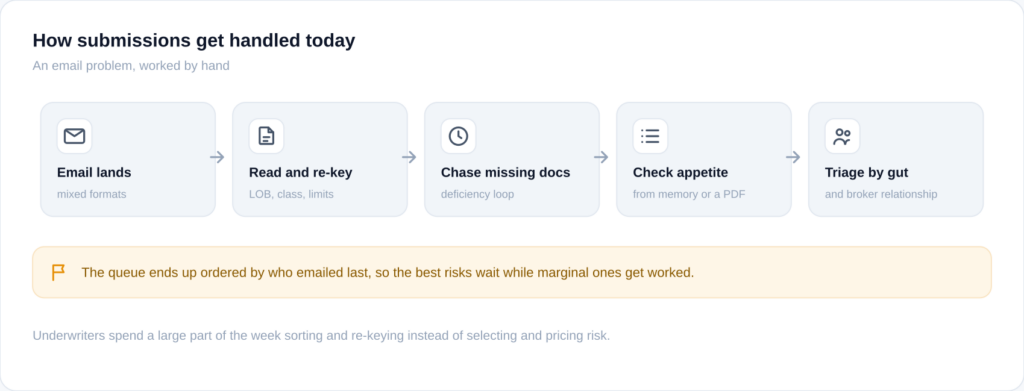
Underwriting digitized everything except the front door
Most carriers run a modern policy system, but the submission still arrives the way it did twenty years ago: an email with attachments in every format. Before a risk can be underwritten it has to be read, keyed in, checked for completeness, and weighed against appetite. A single underwriter can see thirty to a hundred or more of these a week, so the first hour on any risk is data entry and triage, not underwriting, and the queue ends up ordered by who emailed last.
1
Volume beats capacity
Thirty to a hundred or more submissions a week per underwriter, far more than the team can work well.
2
The best risks go cold
Good risks wait while the team reacts to whoever shouted loudest, and brokers bind them elsewhere.
3
Decisions live in people’s heads
Why a risk was declined or set aside is rarely written down, so you cannot audit it or train on it.
4
Leakage shows up late
Off-appetite or mispriced business only shows up at the quarterly loss-ratio review, long after it is bound.
Underwriters are the most expensive people in the operation, and a large part of their time goes to sorting. On a team of ten, the admin load is like three to four full positions spent moving submissions around instead of selecting and pricing risk.
How it works
One workflow, from the inbox to the decision
Insuronix brings four stages into one flow: it reads every submission, ranks them by fit and value, puts everything an underwriter needs on one screen, and learns from every decision. The queue is ordered by a triage score built from six signals: appetite fit, data completeness, risk quality, broker quality, premium size, and how likely you are to win the account. It is built for insurance, it runs read-only against your own systems, and your team approves every action.
Built for insurance
Tuned for commercial P&C: ACORD applications, statements of value, loss runs, and the class codes and appetite language your team uses.
An agent that reads every submission
It reads each package as soon as it arrives and pulls out the fields, so nothing sits in the queue waiting for a person to open it first.
It learns your real appetite
It learns what you write and why from the decisions your underwriters make, not from a guidelines document that goes out of date.
01
Intake and ingestion
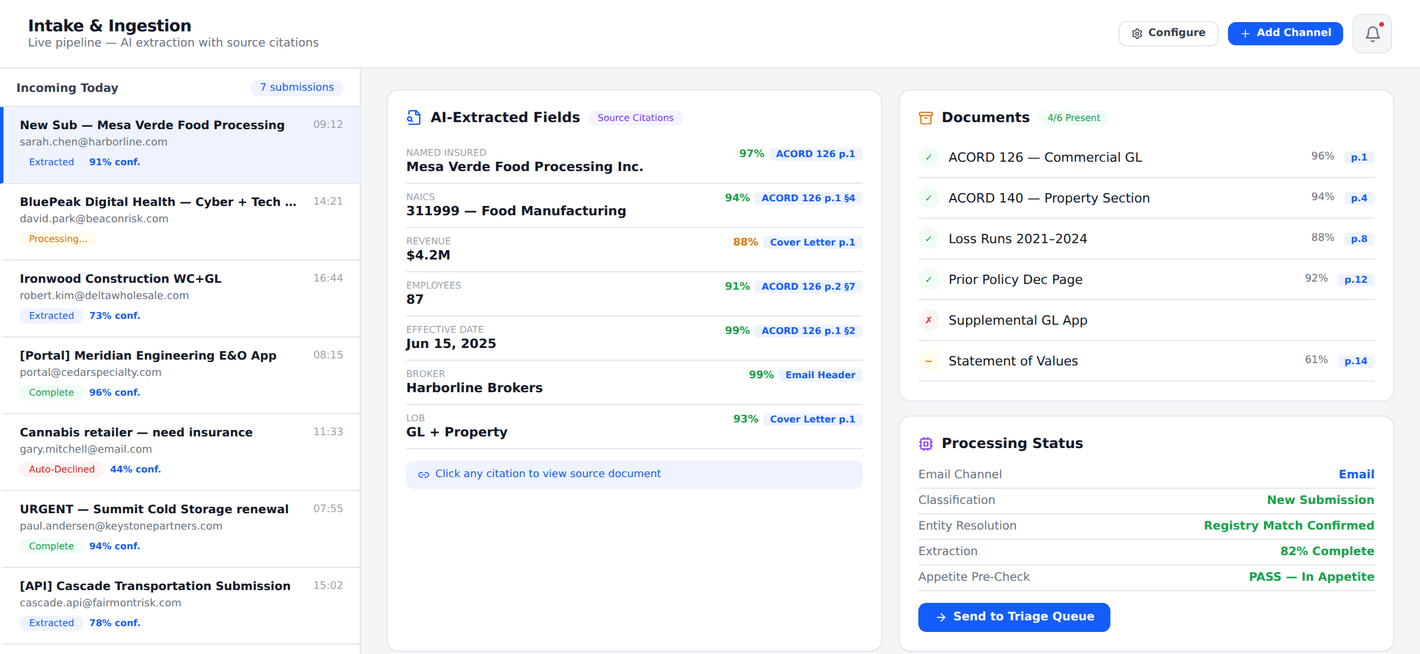
It reads every submission when it arrives
Submissions come in from email, broker portals, and APIs. Insuronix reads the whole package, the application, the statement of values, the loss runs, and the supplementals, and pulls the data into structured fields. Every field shows the document and page it came from, so your team can check it against the source.
- Reads email, portal, and API submissions
- Pulls fields from ACORD forms, SOVs, and loss runs
- A source citation on every field it extracts
02
Decision workbench
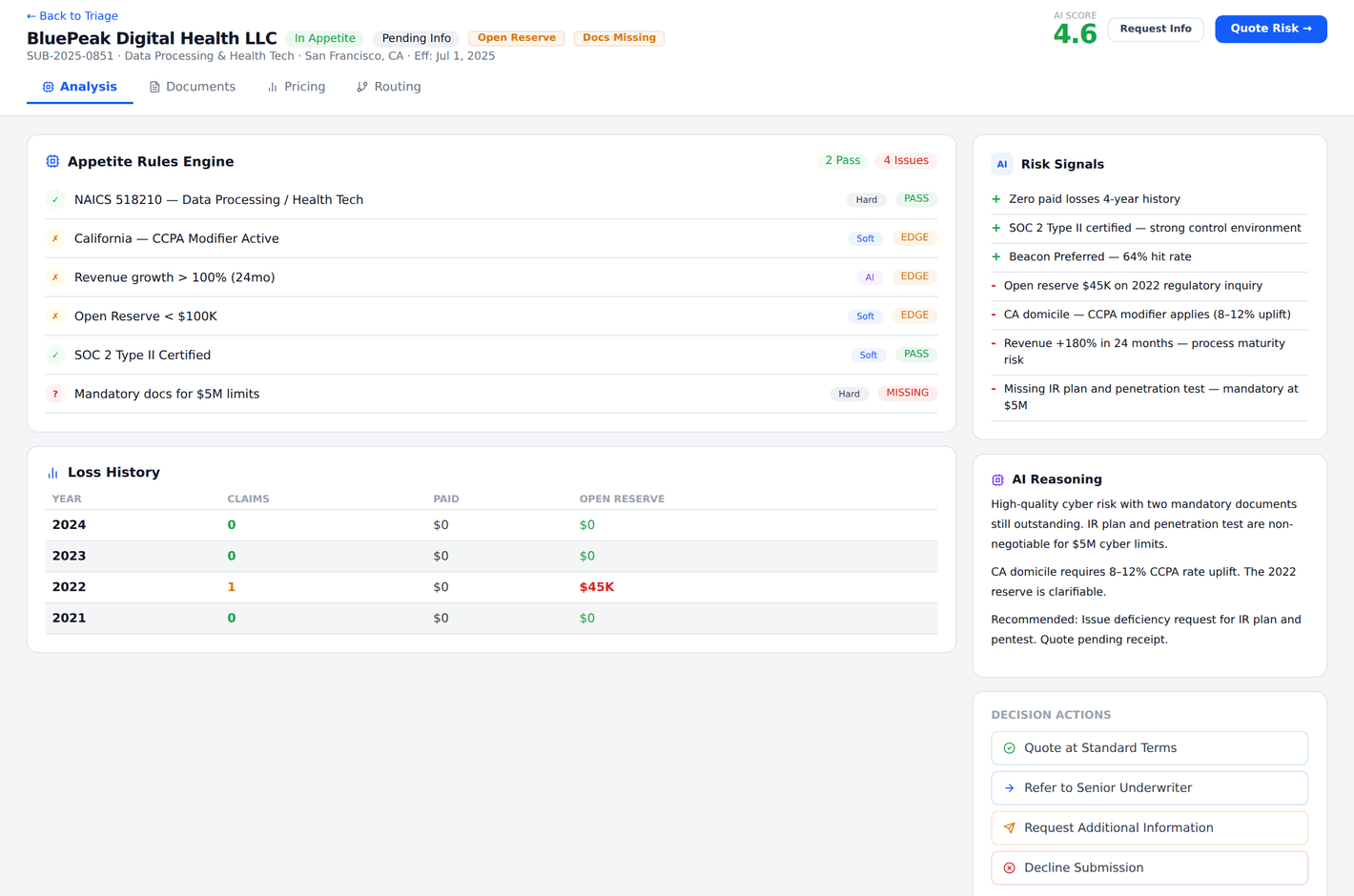
Everything an underwriter needs, on one screen
For each submission, the workbench puts the appetite call, the loss history, the risk signals, and a plain-English summary on one screen. Appetite fit is not a single number: every hard, soft, and learned rule shows as Pass, Edge, or Fail, each with a reason your team can defend and an auditor can follow. Every signal links back to the document it came from.
03
Learning and intelligence
It learns your real appetite over time
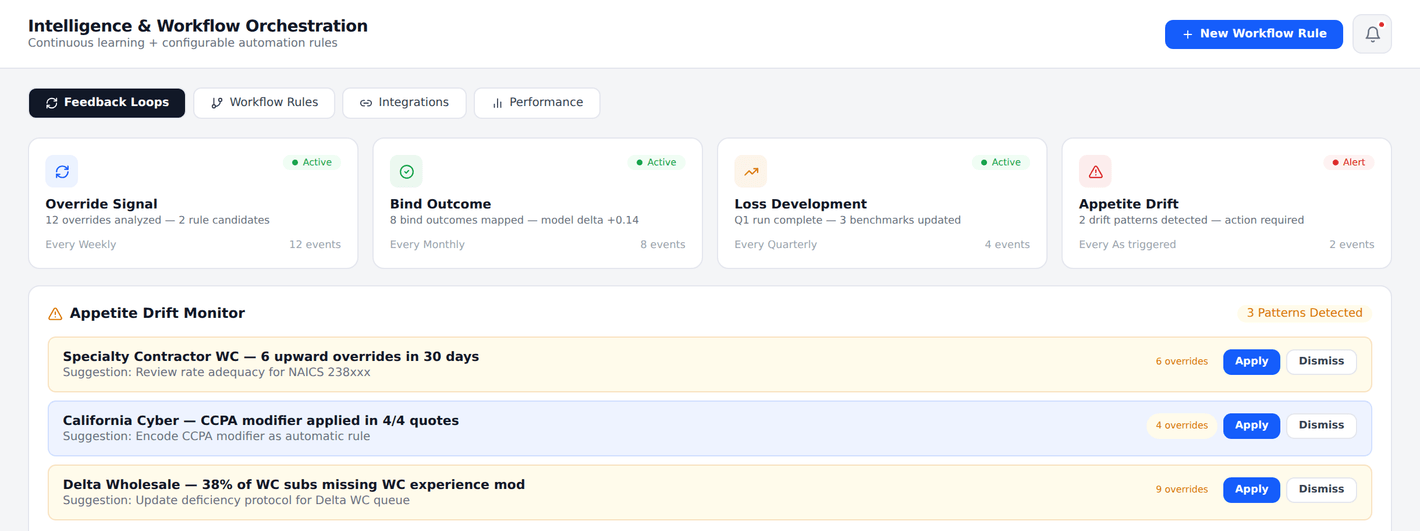
Overrides, bind and decline outcomes, and relevance signals all teach the system what your team writes and why. The rules you set at the start matter less over time as the system learns from those decisions. Its accuracy is designed to climb from around 60% at setup toward 95% and above over a few months, without anyone editing a rule.
- Learns from overrides, bind outcomes, and loss development
- An appetite drift monitor that flags when your written rules fall behind
- No rule editing to keep it current
04
Workflow automation
You decide what happens after each triage
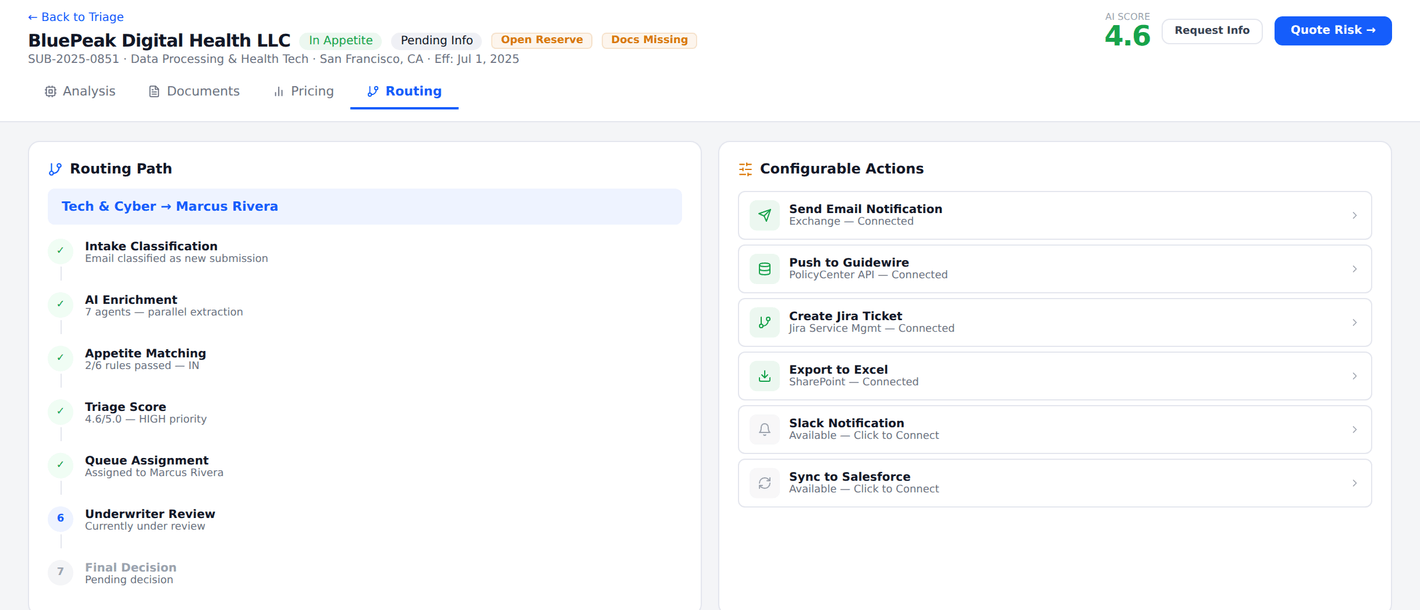
With a simple when, if, then builder, your ops team decides what happens after a triage outcome: assign the risk, escalate it, request missing documents, raise a ticket, or start the quote in your policy system. The underwriter approves each action. Every submission moves through a clear pipeline, from received to actioned, so nothing stalls unseen in a deficiency loop.
- A when, if, then builder, with no IT project
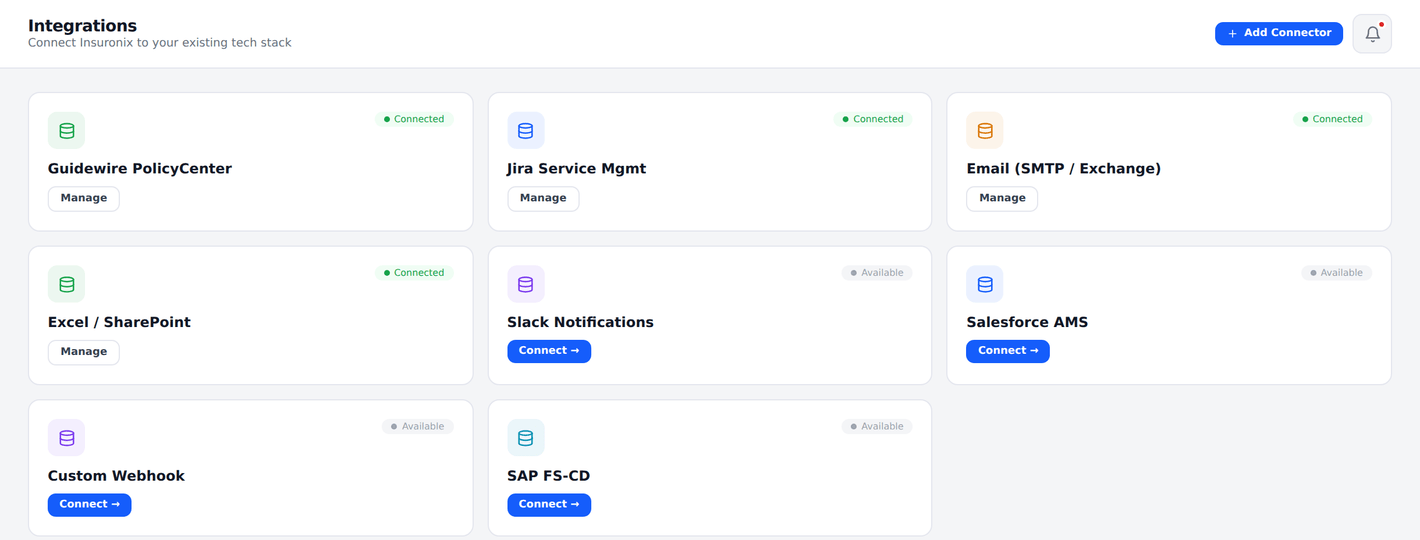
- Works with email, Jira, Slack, spreadsheets, and your PAS
- A clear pipeline from received to actioned
05
Security and fit
It sits above your systems, read-only
Insuronix works as a data processor. It connects to your policy system through read-only access to the data it needs for triage, premium, class codes, loss ratios, and the renewal calendar. It sits above your PAS, so there is no rip and replace and no write access to production. Every output comes with citations and an audit trail, and it supports single sign-on and your data-residency rules.
- Read-only access to your policy system
- Single sign-on and data residency, under your rules
- Citations and an audit trail on every output
What this changes
Made for underwriting and operations
For underwriters
- The queue is ranked by what is worth your time, so the best risks are not waiting behind the loudest ones.
- The appetite call comes with a reason and a citation, so you can defend it to a referral committee and an auditor can follow it.
- Less time reading, re-keying, and chasing documents, and more on the risk selection and pricing you were hired for.
For underwriting operations
- Every submission is tracked from received to actioned, including the ones stuck in a deficiency loop.
- You can measure the funnel and see where risks stall, instead of guessing from email threads.
- Routing, escalation, deficiency emails, and tickets are configured by your team, not built in an IT project.
For the business: the admin load on a team of ten is like three to four underwriters of capacity, and it comes back without hiring. Fewer good risks go cold, and you have a record of how every decision was made.
The numbers
What this can look like
30-40%
Not weeks
Underwriter time on admin work today
3-4
Underwriters
Of capacity lost to sorting on a team of ten
60 → 95%
Relevance
Designed to climb as it learns your decisions
60-80%
Less handling
The manual triage effort it is built to remove
See it on your own submissions
Book 30 minutes with our team. We’ll show you a queue ranked, explained, and priced on realistic submissions for your lines, and what a pilot on your own book would look like.