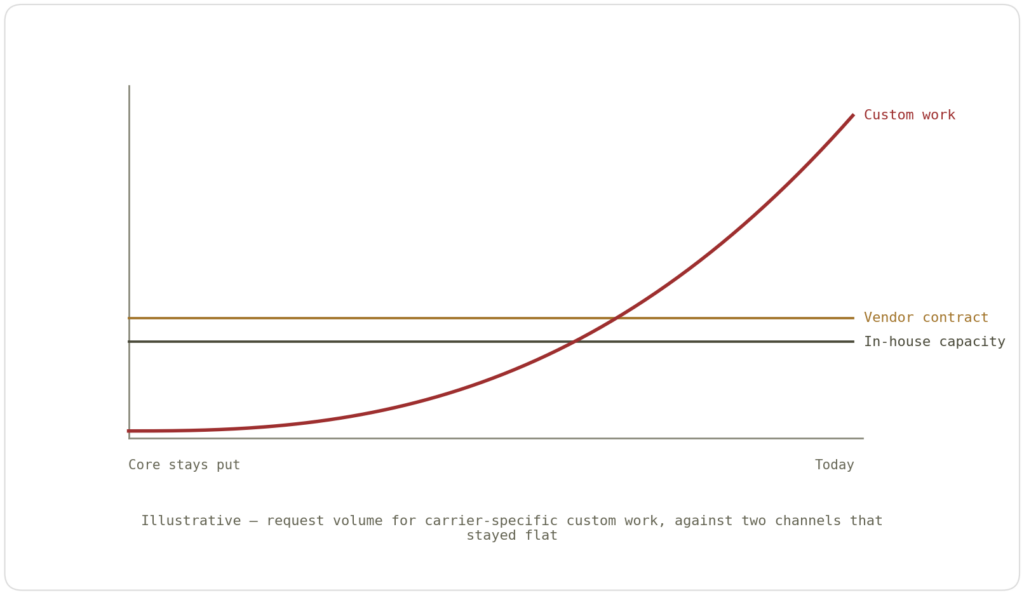
Two channels, both sized for the old, smaller version of this
| | Vendor consulting division | In-house engineering |
|---|
| Built for | Configuration and occasional customization on that vendor’s platform | Core roadmap work |
| What’s landing on it now | A steady stream of requests unrelated to the core system | Carrier-specific requests competing with core priorities |
| Result | Priced and scheduled for occasional work, not volume | Rarely clears the priority bar |
A vendor’s consulting division wasn’t built to handle a steady stream of unrelated requests, like:
- A property schedule cleanup specific to one broker relationship.
- A producer license check built around one carrier’s own rules.
- A report format one team invented years ago and never wrote down.
In-house engineering has the same problem from the other side. The core roadmap sets that team’s calendar. A request specific to one line or one broker usually loses out to everything else competing for the same hours.
Neither channel grew to match the shift. The requests kept arriving at the same two doors, and both were still sized for the smaller version of this problem.
What actually clears a backlog like this
Clearing a backlog like this takes two things at once, and they rarely sit in the same place: insurance fluency, so a workflow doesn’t need a long ramp-up to understand, and build speed, so a request specific to one carrier is still worth taking on.
A general contractor unfamiliar with insurance needs weeks just to understand the request. A slow build loses out to everything else on the list, even when the expertise is right.
This is the specific gap Professional Services at Insuronix fills: consultants who already know the workflows and terms, building fast on Insuronix’s own platform, doing the carrier-specific work that neither a vendor’s consulting division nor an internal team was ever staffed to handle.